




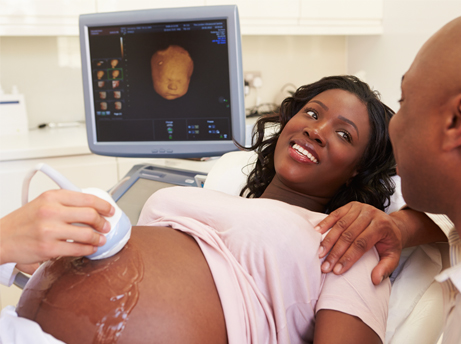
What Is the First Prenatal Visit?
Your first prenatal visit is a 45 to 60 minute appointment, usually scheduled between 8 and 12 weeks of pregnancy. Your board certified physician confirms the pregnancy, establishes your due date, reviews your health history, orders lab work, and often performs an early ultrasound. It also sets the schedule for the rest of your prenatal care.
Most women call for that first appointment a few days after a positive home pregnancy test, which often falls around 6 to 8 weeks from the first day of your last menstrual period. The office may schedule you a few weeks out so that an early ultrasound can pick up a heartbeat and give a reliable due date.
This is the longest visit of your entire pregnancy, for good reason. Everything gathered at this appointment becomes the baseline for the months ahead: your blood pressure, your weight, your blood type, your immunity status, and your personal and family medical history. Bring your questions. At Women’s Physician Group, we want you to leave the first visit knowing what happens next and who to call between appointments. Excitement and nerves tend to show up together at this appointment, and both are welcome in the exam room. Bring your partner, bring your list of questions, and let us care for you from the very beginning.
Step by Step: What to Expect at Your First Prenatal Visit
Your first prenatal appointment follows a predictable order: intake and vitals, a detailed history review, a physical exam, lab work, and a conversation about screening options. Most visits end with a due date and your next appointment on the calendar. Plan for roughly an hour from check-in to checkout.
Why the First Prenatal Visit Matters
The first visit does more than confirm what the home test already told you. It shapes decisions all the way to delivery day.
An accurate due date guides everything. Timing for genetic screening, the anatomy ultrasound, glucose testing, growth checks, and any discussion about induction all depend on accurate dating.
Silent conditions get caught early. Anemia, thyroid disorders, elevated blood pressure, gestational diabetes risk, and asymptomatic urinary infections are far easier to manage when they’re found in the first trimester.
Location and viability are confirmed. An early ultrasound verifies that the pregnancy is inside the uterus and developing as expected, which rules out ectopic pregnancy.
Medications get reviewed. Some prescriptions need to be adjusted or swapped in pregnancy. Prenatal vitamins and folic acid start now if they haven’t already.
You build a relationship with your team. First-trimester nausea, fatigue, spotting, work restrictions, and food questions are all worth bringing up.
Open dialogue matters to us. We want you comfortable enough to say what’s really on your mind, because the questions you hold back are often the important ones. The board certified physicians and nurse practitioners at Women’s Physician Group build this first-visit foundation deliberately, because excellent care with a patient touch depends on knowing your full history long before any symptom shows up.
First Prenatal Visit vs. Later Prenatal Visits
Your first appointment is the longest and most detailed. Routine visits after that are shorter and more focused, typically running 10 to 15 minutes once everything is established.
| First Prenatal Visit | Routine Second & Third Trimester Visits | |
|---|---|---|
| Length | 45 to 60 minutes | 10 to 15 minutes |
| Timing | Usually 8 to 12 weeks | Every 4 weeks to 28 weeks, every 2 weeks to 36 weeks, then weekly |
| Exams | Full physical, breast exam, possible pelvic exam and Pap test | Blood pressure, weight, fundal height, fetal heart tones |
| Lab work | Full panel: blood type and Rh, CBC, immunity screens, infectious disease testing, urine culture | Targeted only: glucose screening at 24 to 28 weeks, Group B strep at 35 to 37 weeks, repeat CBC |
| Ultrasound | Often an early dating scan | Anatomy scan around 18 to 22 weeks, growth scans as needed |
| Topics covered | History, due date, genetic screening, nutrition, medication safety | Fetal movement, symptoms, birth plan, breastfeeding, labor signs |
Visit frequency follows the schedule recommended by the American College of Obstetricians and Gynecologists, though our board certified physicians will see you more often if your pregnancy needs closer watching. Twins, chronic hypertension, diabetes, and a history of preterm birth all shift the schedule.
Cost and Insurance: What Affects Your First Prenatal Visit Bill
Most insurance plans cover prenatal visits as preventive maternity benefits, so your first prenatal visit may cost little out of pocket. What you actually owe depends on your deductible, whether the office is in your network, how the laboratory bills your blood work, and whether ultrasound charges are separate from the office visit.
| Factor | How It Affects Your Bill |
|---|---|
| Deductible status | Unmet deductibles often apply to labs and ultrasounds even when the visit itself is covered |
| Network status | In-network offices bill at contracted rates; out-of-network care usually costs more |
| Lab work | Blood and urine tests are frequently billed by an outside laboratory, arriving as a separate statement |
| Ultrasound | Dating and anatomy scans are typically billed on their own, apart from the visit |
| Global maternity billing | Many plans bundle routine prenatal visits, delivery, and postpartum care into one global charge |
Questions worth asking your insurer before you come in:
Benefits vary widely from one plan to the next, so the answers you get directly from your own insurer will always be more accurate than a general estimate. Ask specifically whether your prenatal labs are processed by an in-network laboratory, since outside lab statements are one of the most common billing surprises in early pregnancy. Keeping every explanation of benefits statement in a single folder throughout the pregnancy makes it much easier to match charges against what your plan already covered, and it gives you a clear record if a claim needs to be reviewed later.
When Should You Schedule Your First Prenatal Visit?
Call to schedule your first prenatal visit as soon as you have a positive home pregnancy test. Most first visits take place between 8 and 12 weeks of pregnancy. If you’ve had a miscarriage, bleeding, pelvic pain, or an IVF pregnancy, ask to be seen closer to 6 or 7 weeks instead.
When you call Women’s Physician Group to schedule, have the first day of your last menstrual period ready, since that date determines which appointment window makes sense for you. If any of the situations listed below apply to you, mention them during the call so an earlier appointment can be arranged.
Ask for an earlier appointment if you have:
Twelve weeks is not too late for a first visit, and plenty of women start there. Earlier care simply widens your options, since some genetic screening tests have narrow windows in the first trimester.
What to bring:
Partners are welcome and encouraged. Two sets of ears catch more than one, and hearing that first heartbeat together is a moment most couples remember.

Frequently Asked Questions About the First Prenatal Visit
How long does the first prenatal visit take?
Plan on 45 to 60 minutes, plus check-in time. Most of that hour goes to reviewing your medical, surgical, menstrual, and family history in detail. Later prenatal visits are much shorter, usually 10 to 15 minutes.
Will I have an ultrasound at my first prenatal visit?
Often, yes. An early ultrasound confirms that the pregnancy is inside the uterus, checks for a heartbeat, and establishes a reliable due date, particularly when your cycles are irregular or your dates are uncertain. Dating scans are commonly performed in an office setting, and the imaging you have later in pregnancy often becomes a bonding experience for you and your loved ones as you get an early look at your newest addition.
Is 12 weeks too late for a first prenatal visit?
No, 12 weeks is not too late, and many women have their first visit right at that point. Starting earlier gives you a wider window for first-trimester genetic screening and more time to address conditions like anemia or thyroid disease. If you’re already past 12 weeks, call and get scheduled soon rather than waiting longer.
Should my husband or partner come to the first prenatal appointment?
Partners are welcome at the first visit and at every visit after it. Having your husband or partner there helps with remembering instructions, and it means you both hear the due date and see the early ultrasound at the same time. Some couples split it up, with the partner joining for the ultrasound portion if work schedules are tight.
Do they do a pelvic exam or Pap smear at the first prenatal visit?
Sometimes. A pelvic exam and Pap test are performed if you’re due for cervical cancer screening or if there’s a specific reason to examine you, such as bleeding or discharge. If your last Pap was recent and normal, you may not need one. Your physician will explain what’s being done and why before starting.
What questions should I ask at my first prenatal appointment?
Write them down beforehand so nothing gets forgotten. Useful ones include: